Showing posts with label air handling unit. Show all posts

Thursday, March 5, 2026

The role of building automation systems (BAS) in maximizing AHU efficiency

 Air Handling Units are at the heart of most commercial HVAC systems, yet they are also one of the biggest sources of hidden energy waste when not operated correctly. In many buildings, AHUs are mechanically sound but digitally underutilized, running longer than needed, supplying more air than required, or operating at fixed setpoints that no longer reflect real occupancy or load conditions. This is where Building Automation Systems (BAS) play a critical role.

When properly integrated, BAS transforms an air handling unit from static mechanical equipment into a responsive, data-driven system that adapt continuously to building demand. The result is improved thermal comfort, lower energy consumption, and extended equipment life.

Why AHU efficiency depends on control, not just design

Most modern AHUs are designed with high-efficiency fans, optimized coils, and energy-recovery options. However, efficiency on paper does not guarantee efficiency in operation. Without intelligent control, even the best AHU design can waste energy through:

  • Constant volume operation during partial loads
  • Fixed supply air temperatures across varying conditions
  • Simultaneous heating and cooling
  • Poor coordination with VAV boxes or terminal units

BAS addresses these inefficiencies by dynamically adjusting how the AHU operates, based on real-time data rather than static assumptions.

Key BAS functions that improve AHU performance

A well-configured BAS continuously monitors temperature, humidity, airflow, pressure, and occupancy signals. Using this data, it optimizes AHU operation in several important ways.

One of the most impactful is the supply air temperature reset. Instead of maintaining a constant low temperature, the BAS adjusts supply air temperature based on actual zone demand. This reduces unnecessary cooling and significantly lowers chiller and reheat energy.

Another major contribution is fan speed optimization. Variable frequency drives (VFDs) controlled through BAS allow fan speed to modulate according to system pressure requirements. Since fan energy increases exponentially with speed, even small reductions result in substantial energy savings.

BAS also enables demand-controlled ventilation, where fresh air intake is adjusted using CO₂ sensors or occupancy data. This ensures indoor air quality is maintained without over-ventilating empty or low-occupancy spaces.

Improved coordination between AHUs and the wider HVAC system

Air handling units do not operate in isolation. Their efficiency depends on how well they are coordinated with chillers, pumps, terminal units, and exhaust systems. BAS acts as the central intelligence layer that synchronizes these components.

For example, when zone demand drops, the BAS can reduce airflow, raise chilled water temperatures, and lower fan speeds simultaneously, avoiding the inefficiency of one system compensating for another. This system-level optimization is where many buildings achieve their largest operational savings.

Fault detection and predictive maintenance

Another often overlooked benefit of BAS is its role in fault detection. Gradual performance issues, such as clogged filters, stuck dampers, sensor drift, or coil fouling, often go unnoticed until comfort complaints arise.

With BAS analytics, deviations from expected AHU performance can be flagged early. This allows maintenance teams to intervene before efficiency drops or equipment stress leads to failure. Over time, this predictive approach reduces unplanned downtime and extends the service life of the air handling unit.

Why BAS matters more in large and complex buildings

In hospitals, airports, malls, and high-rise commercial buildings, AHUs serve multiple zones with varying usage patterns. Manual control or basic timers cannot handle this complexity effectively. BAS provides the adaptability required to manage fluctuating loads while maintaining compliance with energy and indoor air quality standards.

For manufacturers and system integrators, designing AHUs that are fully compatible with modern BAS platforms is no longer optional; it is essential for delivering real-world efficiency.

Maximizing AHU efficiency is no longer about hardware alone. The real performance gains come from intelligent control. Building Automation Systems unlock the full potential of air handling unit by aligning operation with actual demand, improving coordination across HVAC systems, and enabling proactive maintenance. For buildings aiming to reduce energy costs without sacrificing comfort, building automation systems is a necessity.

Wednesday, November 5, 2025

Smart building integration: How AHUs connect with BMS for UAE facility efficiency

 Facility owners in the UAE are increasingly adopting Building Management Systems (BMS) to improve energy efficiency and operational oversight. These centralized platforms provide real-time monitoring and control of HVAC, lighting, and safety systems, ensuring buildings perform at their design potential. The effectiveness of a BMS, however, depends on the data and functionality delivered by connected equipment such as the air handling unit.

How AHUs interface with BMS platforms

Modern AHU designs are equipped with sensors, variable frequency drives, and digital controllers that communicate with BMS platforms. Parameters such as airflow, temperature, humidity, and filter status are transmitted continuously, giving facility managers full visibility of system performance. This data-driven approach allows early detection of issues like coil fouling, pressure drops, or fan inefficiencies, reducing unplanned downtime and maintenance costs.

Optimizing energy performance

Integration enables dynamic control strategies that balance comfort and efficiency. For example, BMS platforms can adjust fan speeds in response to occupancy levels, optimize cooling setpoints based on outdoor temperature, and schedule equipment to match building usage.

When applied to an air handling unit, these strategies cut energy consumption without sacrificing indoor air quality. In high-demand climates like the UAE, the savings can be substantial, particularly in large commercial or mixed-use facilities.

Supporting indoor air quality standards

Air quality is a growing concern in the region, and regulatory standards demand close monitoring. By integrating AHUs with a BMS, operators can track humidity levels, filter performance, and ventilation rates in real time. Alarms can be configured to alert teams when CO₂ levels rise or when filters need replacement. This proactive approach not only ensures compliance but also improves occupant comfort and well-being.

Predictive maintenance and lifecycle benefits

Another advantage of integration is predictive maintenance. Continuous monitoring of component performance, such as fan vibration or motor current, helps identify early warning signs of wear. Maintenance teams can plan interventions before failures occur, extending the life of expensive equipment and reducing costly emergency repairs. AHUs that share this data with BMS platforms transform maintenance from a reactive task into a strategic asset.

Driving long-term value for UAE facilities

Smart building integration is central to achieving sustainable, efficient operations. By connecting every AHU to the BMS, facility owners gain greater control, lower operating costs, and improved compliance with environmental standards. For UAE projects focused on performance and sustainability, selecting the right air handling unit and ensuring seamless integration with building management platforms is key to long-term value.

Tuesday, September 3, 2024

The importance of proper air handling unit sizing

 The essential component of any HVAC system is the air handling unit (AHU) of a building, which provides conditioned air throughout. The dimensions of the AHU should not only accommodate the available space in the plantroom and adhere to building requirements, but also accommodate the filters, heat exchangers, and maintenance and fan access sections.


Correctly sizing this critical component is essential for efficient, effective environmental control. There are a few factors to take into account while determining the AHU's size.


  • Match capacity to demand

Oversized or undersized AHUs cause problems. It is too small, and areas won't reach the desired temperatures, frustrating occupants. Oversized wastes energy by short-cycling compressors excessively. Consult reputable air handling unit UAE suppliers to accurately determine a space's heating/cooling demand before selecting nominal unit capacity. 


  • Factor runtime needs

AHU sizing also affects runtime. Short, frequent cycles strain components unnecessarily versus steady runtime. Consider internal/external heat loads plus desired runtime when selecting an air handling unit best suited to duty cycle needs rather than just peak capacity alone. Longer cycles ease the strain on parts.


  • Ensure adequate airflow

Design supply air volume specifically for the zone's ventilation requirements. Under-airflow risks compromising indoor air quality and thermal comfort. Over-ventilation wastes conditioned air and energy. Careful calculations factoring zone cubic footage and air changes per hour are needed from air handling unit suppliers.


  • Consider ductwork design

The unit selected must be appropriately sized for static pressure and friction losses within the duct system laid out for the building. Oversized blowers push more air volume than ducts can handle, straining duct joins prematurely. Design static pressure drops into unit selection.

  • Allow operational flexibility

Variable speed fans and compartmentalized coils enable partial load operation down to 10-20% capacity as conditions allow. This saves energy versus cycling large AHUs on and off in part-load situations. Consider future flexibility when selecting air handling units from suppliers in the UAE.


Properly sizing AHUs involves thorough heat/ventilation load analysis and factoring installation variables. The benefits are optimized comfort, efficiency, and equipment/component lifespan. Rely on qualified engineers from reliable manufacturers like Trosten Industries whose Eurovent-certified AHUs have the best mechanical performance.


Monday, January 29, 2024

Architecture and the challenges of indoor air quality

  Air handling units bring in essential components to create an indoor atmosphere that is both comfortable and healthy. The center of the operations is the fan which works effortlessly to push air out of the system. The next are filters which capture dust and pollutants to enable healthy air to circulate in the indoor space. Cooling and heating coils, humidifiers, and dehumidifiers help in fine-tuning the temperature and humidity. Dampers work by controlling the airflow while the mixing chamber circulates indoor and outdoor air.

The indoor air quality solutions that are suggested during building design must take particular users and situations into account. The kind of building in issue greatly influences the decisions and trade-offs made about ventilation systems, as well as the volume and velocity of airflow.

Filter maintenance

Filters play an essential role as routine maintenance can help in avoiding airborne pollutants. Regular inspections and correct time filter replacements ensure smooth working. Moisture is also a challenge for AHUs, as microbial growth can develop within the system which can create mold and bacteria in indoor space. Keeping a regulated humidity level is the key to avoiding microbial growth. 

Ventilation rates

Ventilation is highly important to predict the air exchange, low rates of air exchange can end up in a buildup of pollutants which can disrupt the balance of IAQ. Architects carefully create design ventilation systems to enable a straight flow of air. Not all pollutants can inevitably be caught through the filters. Any gases, odors, and organic compounds can also not be caught through the best working AHU. Experts must be aware of addressing these challenges and apply additional strategies to work against these contaminants.

Duct contamination

In the complex ductwork of an air handling unit, dust and debris can collect which is detrimental to its performance. Routine cleaning and maintenance are the core of keeping AHU working efficiently.

In spaces where there are high amounts of outdoor air pollution, generally filtering the intake air can be the best solution to enable a good IAQ. Any extra air filtration stages or alternative ventilation strategies can be beneficial. It is a challenging task to balance IAQ with energy efficiency. Increasing ventilation rates enable improved IAQ but also leads to higher energy consumption. 

Specialists have looked for further strategies to enhance AHUs for better IAQ and energy efficiency. Architecture and AHUs play an essential role in shaping indoor air quality. Only by understanding the challenges and applying good strategies can architects create buildings with better IAQ. This will allow to better the occupant’s health and well-being. 


Monday, December 27, 2021

What are the types of AHU?

 AHU or Air Handling Unit or Air Handler handles the air to be supplied through the ventilation ducts into the building and return it to the AHU. Basically, to ensure that air is delivered with thermal efficiency. The AHU treats the air by filtering, cooling, and / or heating, humidifying or dehumidifying. Air handling units are important part of HVAC systems, both in residential and commercial areas.

Air Handling Units


An AHU is a metal box having multiple components, channel racks / chambers and dampers which can have design variation as per requirement. Air Handling Units (AHU) with double skin panel construction are Hygienic.

Trosten is one of the best AHU manufacturer in the UAE and their AHUs are certified by TUV Nord, Germany.

We can classify the AHUs as per their usage.

  • Terminal Units are small AHUs for local use. They may have only an air filter, coil and a blower.
  • Makeup Air Units are large Air Handling Units that condition the outdoor air 100%. They do not circulate the air again.
  • Packaged unit is also known as Rooftop Unit (RTU) is designed for outdoors, like roofs.

Let us look at the components of Double Skin Air Handling Units.

  • Blower: One of the most important components of the Double Skin AHU, it helps recycle air in a building. The air inside a blower is properly conditioned.
  • Filter: Filters help to remove the dust and other contaminating particles.
  • Conditioning elements: They help heat or cool the air, as per the requirement.
  • Humidifier: This help maintain the air quality in cold climatic conditions.

Regardless of the kind of AHU, regular maintenance and servicing is an absolute must. This ensures an increase in the durability, functioning and longevity of the Air Handlers.

Trosten manufactures AHU with both direct expansion and chilled water system, after thoroughly understanding the need of the market. The capacity of the Trosten Double Skin AHU varies from 600 CFM to 80,000 CFM, thus making them an ideal choice for big HVAC systems as well.

Trosten has ensured that there is the least chance of microbial growth in its HVAC units installed with its double skin AHU. These AHUs are energy efficient.

Trosten ensures best product quality and customer service.

Tuesday, November 2, 2021

All about Eurovent certified Air Handling Units


Eurovent classification is a new classification specified in the rating standards from 1st January 2016. As per the standards certain critical parameters are taken in to account to determine and efficiency of the air handling units. Eurovent certified air handling units consists of a fan or other accessories to perform the functions like circulating, heating, filtrating, humidifying, heat recovery etc. They are suitable to be used in the duct works. Air handling units are available in different sizes and units of same sizes are grouped under the same designation by using the similar selection procedures.

Air handing units are useful in establishing mechanical, thermal and acoustic performance according to manufacturer’s specifications. Eurovent certified air handling units offer several certified mechanical and performance characteristics like heating capacity, cooling capacity, heat recovery, static pressure, acoustic insulation of casing etc. A unit classified under ‘A’ category as per Eurovent clarification represents at least 28% more efficiency than the units formerly classified under ‘A’ category.

 Trosten Industries supplies certified centralized air conditioning and kitchen ventilation equipment for residential, commercial and industrial applications. They are considered to be among the top Eurovent certified AHU manufacturers in the GCC region. The Company offer services to the customers by offering high ecological returns. They are committed to satisfy their customer needs and preferences.


Tuesday, September 14, 2021

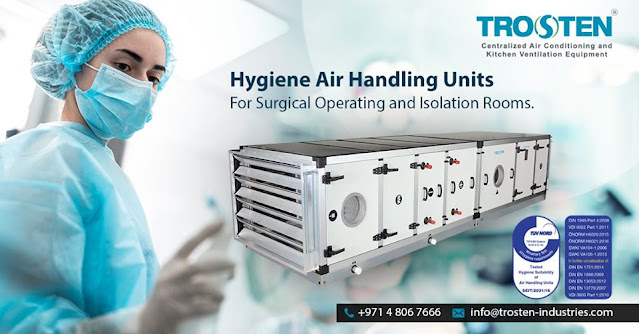
Differences between regular AHU and Hygienic AHU

Commonly called an AHU, an air handling unit has now become essential in many residential and commercial areas like data centers, hospitals, laboratories, offices etc to cool the indoor environments. It consists of a large metal box containing a blower, heating or cooling elements, dampers, sound absorbers and filter racks. Trosten specializes in manufacturing hygiene units with different configurations built to promote higher levels of hygiene in hospital environments all across the GCC region.

 So, what are the differences between regular AHU and Hygienic AHU?

 An air handling unit (AHU) filters and controls air quality in the indoor space with its air purification filter. These filters are intended for spaces where natural ventilation is limited and there is a crowd of people walking in and out of the premises. These AHU’s collect air from outside, which is treated and distributed throughout the rooms after being recycled.

 It regulates the air conditioning and conditions the temperature so that the environment is set to a comfortable temperature.

It monitors the humidity levels and with heat recovery units AHUs can reduce the consumption of energy needed in an air conditioner. The indoor and outdoor air is mixed so that when the air comes in contact with the coil the temperature contrast is lower making the climate contribution also lower. Some components of an AHU are

       Filter: It purifies the air and can be adjusted according to the air purity requirements to filter out bacteria, air pollutants and viruses.

      Fan: This electromechanical system powers the air to expel unhygienic air from the AHU to the ducts.

      Heat exchangers: These devices transfer temperature between two fluids - the coolant and the air which is then separated by a solid barrier. 

Hygienic Air Handling Units or Hygienic AHUs are used in industries that need to give importance to maintaining a sensitive sterile environment and maximise hygienic conditions. They are used in pharmaceutical and medical industries, operating theaters and food industries.

It provides greater efficiency than a regular AHU in terms of filtration and is installed to better manage the indoor environment while reducing energy consumption and avoiding the spread of bacteria. Its hygienic sound absorbers are placed in the AHU to reduce the dust particles in the ductwork.

Hygienic Air Handling Units are coated with stainless steel and are covered with special joining pieces and sheets to prevent water accumulations and present a straight and smooth surface.

Trosten offers high quality air handling units that elevate the performance of centralized heating, ventilation and air conditioning equipment for various industries.