Saturday, October 15, 2022

An Overview on Latest HVAC & Sensor Technologies

 The machinery that maintains a suitable temperature in your house has typically had only one purpose: to heat as well as cool your interior rooms. It was the thermostat or control system that gave the impression that the HVAC system was adjusting its efficiency to be more energy efficient. The HVAC system's technology is becoming smarter than conventional HVAC equipment once this advanced sensor technology is applied directly to it.

The HVAC industry is advancing sensor technology in a range of important sectors, such as increased durability to tolerate challenging HVAC surroundings, digital communication functionality, the capacity to observe numerous physical dimensions with a single sensor, reduced power sensors, wireless expertise with a wide range of communications protocol alternatives, and smaller sensors to save room. 

Sensors are increasingly becoming a significant element of HVAC systems as energy conservation and quality of indoor air have started becoming more essential, and your consumers demand advanced features.

Listed below are the latest sensor technologies utilized in the HVAC industry:

Temperature Sensors

Both air and water temperatures are measured by the temperature sensor. In essence, the present energies are shifted in the direction of a specified point inside the system. Quality of air and room ventilation are also included in the sensor data. The main advantage is the fact that the sensor limits the system's operation to the type of rodent that the building needs. As a result of efficiency, this prevents energy losses and provides the property with the best possible comfort.

Occupancy Sensors

An automated system gets signals from the occupancy sensor about whether people are present in the property or designated location. For example, when there is an occupant present, the sensors pick up movement and immediately switch on the lights. When there is an occupant present, HVAC systems regulate the temperatures or airflow to the preset setting.

Pressure Sensors

The pressure sensor detects changes in pressure within predetermined zones and notifies the system when repairs or replacing are necessary. For example, the sensor analyzes high or low pressures in both water and air, and when an irregularity is found, it warns the unit. It is typically used with variable air volume control or air quality monitoring devices.

Looking for the best HVAC equipment and HVAC suppliers in UAE that provides all these latest smart technology HVAC systems? Trosten is your best partner!

Friday, September 30, 2022

What is the difference between AHU & FCU?

 Selecting the right air conditioner for your house is crucial. Finding the greatest AC unit may not initially appear difficult, but as you learn about concepts like FCU and AHU conditioning systems, things start to get much more difficult. Here, you must consider the question of what distinguishes fan coil units from air handling units.

Fain Coil Units

Compact, standalone fan coil units condition the air and deliver it throughout the space using the least amount of ductwork possible. They are often found in single rooms and can be utilized to control small loads while recirculating the air. They can be put vertically against one wall, exposed, beneath the floor, or disguised in ceilings, making them highly adaptable and reasonably priced.

It frequently comprises a fan and an exchanger for cooling or heating purposes. The fan coil unit will be placed in the same room as the fans. This is simply controllable, either physically or through a thermostat. Fan coil units are popular among some consumers because they allow for a great range of customization and eliminate the need for ducting. It doesn't draw air externally; instead, they circulate the air within. These smaller fan coil units are frequently referred to as terminal units since they can appear to be hanging.

Air Handling Units

Air handling units could be delivered to the job site in components or as a fully assembled single unit. If the item is delivered in modules, they will be joined together during assembly to form a bigger single container unit. Once built and operational, the air handling unit is intended to provide fully conditioned air to the various building sectors and spaces, enabling the management of much bigger loads than with the FCU.

These units are the finest air conditioners because of how much air they can manage. Most don't, while some of them circulate the inside air. Makeup air units are those that don't circulate indoor air. Even though most are located on the side of buildings, you can still see air handling units there. The most crucial factor you should consider is that these are among the most common varieties of air conditioning equipment.

Still doubtful about fan coil units and air handling units? Reach out to TROSTEN, your one stop destination for all HVAC units!


Wednesday, August 17, 2022

Why Indoor Air Quality in School Must be Everyone's Priority

 Given that students spend a substantial percentage of their time indoors in classrooms, indoor air quality in schools has recently attracted a lot of attention. The degree of environmental ventilation determines the combined effect of physical, biological, and chemical impacts on the quality of the air inside schools. The lack of an accurate hygienic air handling unit system is the major root cause for most of the air quality problems. 

There is ample evidence to suggest that students' health, productivity, and physical and mental development are significantly impacted by indoor environmental quality (IEQ), which encompasses visual, auditory, thermal comfort, and indoor air quality. Inadequate IEQ in schools has also been found to have a negative impact on staff health, absenteeism, and teaching quality.

The effects on health, well-being, or the physical plant may not always be immediately apparent when there are mild indoor air quality issues. Installation of a well-functional hygienic air handling unit can help reduce the air quality issues and control diseases such as eye, nose, throat, and skin irritation, headaches, exhaustion, shortness of breath, sinus congestion, coughing, and sneezing, dizziness, and nausea. Aside from additional factors like inadequate lighting, stress, noise, and more, symptoms may not always be related to poor air quality. IAQ issues may affect a group of individuals or just one person, and they may affect each person differently due to the diverse sensitivities among school residents.

Particularly sensitive populations may exist for pollutants or pollutant mixes. For instance, exposure to carbon monoxide may have a greater harmful effect on those with heart disease than on healthy people. Respiratory illnesses are also more likely in those who are exposed to high levels of nitrogen dioxide.

Additionally, children's developing bodies may be more vulnerable to environmental exposures than adults are. In proportion to their physical weight, children consume more food and liquids than adults do. As a result, the air quality in schools is a major concern. In addition to "quality," maintaining indoor air properly also involves safety and good stewardship of the money you've invested in your facilities, staff, and students.

Installation of a proper hygienic air handling unit can keep indoor air safe and ensure that the ventilation system is operating as effectively as possible. Children's developing bodies may be more vulnerable than adults to the effects of poor air quality, which is why it is so important to take precautions to ensure that schools have the best possible indoor air quality.

Searching for the most hygienic air handling unit near you? TROSTEN is a recognized hygiene unit manufacturer and your best partner! Reach out to us today!


Thursday, June 30, 2022

Why do people prefer installing ducted air conditioning systems?

  A central fan coil is installed in a ducted air conditioning system. This is then connected to specific areas via a network of ducts, allowing you to chill your whole house or business building.

Here are a few reasons why people prefer installing ducted air conditioning systems:

Zoning and Control

One of the most significant advantages of air duct air conditioning systems is the ability to chill every section of your home and manage the temperatures of different rooms. That means you may set different temperatures for all the places allowed in your zones depending on your unit and zone management system.

Unlike window or wall air conditioners, which provide one temperature for everybody, duct air conditioners allow you to tailor temperatures in your areas and switch off temperature control in unoccupied rooms. Everyone may enjoy their desired temperatures without interfering with the central system thanks to ducted air conditioning. It ensures equal air circulation across all rooms, providing you with comfort and peace of mind. During the winter, you may use a reverse cycle ducted air conditioner to keep your room comfortable.

Zero Noise

A loud air conditioning system might disturb your sleep and lead you to lose your temper. Unlike standard split system air conditioners, which are always humming and making noise, some ducted air conditioners are virtually silent. The compressor system for ducted air conditioning is located outside the home, away from the rooms, giving you peace of mind and the environment, you prefer.

Cost-Effective

Air conditioning electricity costs may add up quickly, especially if you have many units in your house. You won't need more than one duct air conditioner to chill the rooms using duct air conditioning. You may also regulate the temperature in each location and turn off the thermostat in empty areas. It's straightforward to adjust cooling in specific regions because it's a central system.

Powerful

Another significant advantage of having ducted air conditioning is that it allows you to chill your home more quickly. Within minutes of turning, it on, it cools the entire house. To switch on the air conditioning, you do not need to walk from one room to another. The capability of this centralized system allows you to rapidly change the temperature of the entire house from a single location.

On a quest to find the perfect ducted split air conditioner. Reach out to Trosten, the renowned ducted split air conditioner supplier in UAE.


Monday, December 27, 2021

What are the types of AHU?

 AHU or Air Handling Unit or Air Handler handles the air to be supplied through the ventilation ducts into the building and return it to the AHU. Basically, to ensure that air is delivered with thermal efficiency. The AHU treats the air by filtering, cooling, and / or heating, humidifying or dehumidifying. Air handling units are important part of HVAC systems, both in residential and commercial areas.

Air Handling Units


An AHU is a metal box having multiple components, channel racks / chambers and dampers which can have design variation as per requirement. Air Handling Units (AHU) with double skin panel construction are Hygienic.

Trosten is one of the best AHU manufacturer in the UAE and their AHUs are certified by TUV Nord, Germany.

We can classify the AHUs as per their usage.

  • Terminal Units are small AHUs for local use. They may have only an air filter, coil and a blower.
  • Makeup Air Units are large Air Handling Units that condition the outdoor air 100%. They do not circulate the air again.
  • Packaged unit is also known as Rooftop Unit (RTU) is designed for outdoors, like roofs.

Let us look at the components of Double Skin Air Handling Units.

  • Blower: One of the most important components of the Double Skin AHU, it helps recycle air in a building. The air inside a blower is properly conditioned.
  • Filter: Filters help to remove the dust and other contaminating particles.
  • Conditioning elements: They help heat or cool the air, as per the requirement.
  • Humidifier: This help maintain the air quality in cold climatic conditions.

Regardless of the kind of AHU, regular maintenance and servicing is an absolute must. This ensures an increase in the durability, functioning and longevity of the Air Handlers.

Trosten manufactures AHU with both direct expansion and chilled water system, after thoroughly understanding the need of the market. The capacity of the Trosten Double Skin AHU varies from 600 CFM to 80,000 CFM, thus making them an ideal choice for big HVAC systems as well.

Trosten has ensured that there is the least chance of microbial growth in its HVAC units installed with its double skin AHU. These AHUs are energy efficient.

Trosten ensures best product quality and customer service.

Tuesday, November 2, 2021

All about Eurovent certified Air Handling Units


Eurovent classification is a new classification specified in the rating standards from 1st January 2016. As per the standards certain critical parameters are taken in to account to determine and efficiency of the air handling units. Eurovent certified air handling units consists of a fan or other accessories to perform the functions like circulating, heating, filtrating, humidifying, heat recovery etc. They are suitable to be used in the duct works. Air handling units are available in different sizes and units of same sizes are grouped under the same designation by using the similar selection procedures.

Air handing units are useful in establishing mechanical, thermal and acoustic performance according to manufacturer’s specifications. Eurovent certified air handling units offer several certified mechanical and performance characteristics like heating capacity, cooling capacity, heat recovery, static pressure, acoustic insulation of casing etc. A unit classified under ‘A’ category as per Eurovent clarification represents at least 28% more efficiency than the units formerly classified under ‘A’ category.

 Trosten Industries supplies certified centralized air conditioning and kitchen ventilation equipment for residential, commercial and industrial applications. They are considered to be among the top Eurovent certified AHU manufacturers in the GCC region. The Company offer services to the customers by offering high ecological returns. They are committed to satisfy their customer needs and preferences.


Tuesday, September 14, 2021

Differences between regular AHU and Hygienic AHU

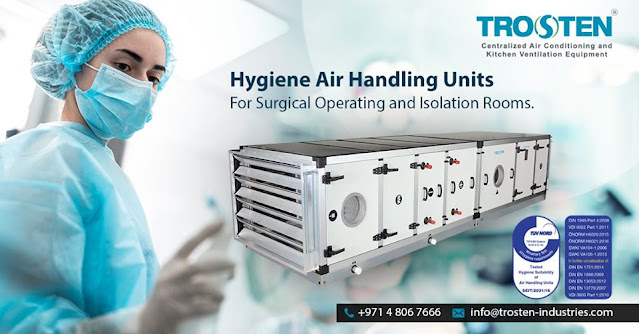
Commonly called an AHU, an air handling unit has now become essential in many residential and commercial areas like data centers, hospitals, laboratories, offices etc to cool the indoor environments. It consists of a large metal box containing a blower, heating or cooling elements, dampers, sound absorbers and filter racks. Trosten specializes in manufacturing hygiene units with different configurations built to promote higher levels of hygiene in hospital environments all across the GCC region.

 So, what are the differences between regular AHU and Hygienic AHU?

 An air handling unit (AHU) filters and controls air quality in the indoor space with its air purification filter. These filters are intended for spaces where natural ventilation is limited and there is a crowd of people walking in and out of the premises. These AHU’s collect air from outside, which is treated and distributed throughout the rooms after being recycled.

 It regulates the air conditioning and conditions the temperature so that the environment is set to a comfortable temperature.

It monitors the humidity levels and with heat recovery units AHUs can reduce the consumption of energy needed in an air conditioner. The indoor and outdoor air is mixed so that when the air comes in contact with the coil the temperature contrast is lower making the climate contribution also lower. Some components of an AHU are

       Filter: It purifies the air and can be adjusted according to the air purity requirements to filter out bacteria, air pollutants and viruses.

      Fan: This electromechanical system powers the air to expel unhygienic air from the AHU to the ducts.

      Heat exchangers: These devices transfer temperature between two fluids - the coolant and the air which is then separated by a solid barrier. 

Hygienic Air Handling Units or Hygienic AHUs are used in industries that need to give importance to maintaining a sensitive sterile environment and maximise hygienic conditions. They are used in pharmaceutical and medical industries, operating theaters and food industries.

It provides greater efficiency than a regular AHU in terms of filtration and is installed to better manage the indoor environment while reducing energy consumption and avoiding the spread of bacteria. Its hygienic sound absorbers are placed in the AHU to reduce the dust particles in the ductwork.

Hygienic Air Handling Units are coated with stainless steel and are covered with special joining pieces and sheets to prevent water accumulations and present a straight and smooth surface.

Trosten offers high quality air handling units that elevate the performance of centralized heating, ventilation and air conditioning equipment for various industries.